
Curriculum Development
MAPS Psychonaut Training
Scaled a niche educational concept into a foundational, high-fidelity global curriculum, managing 20,000+ data points and iterative pilot cycles to bridge the gap between medical research and public harm reduction.
Client
MAPS (Multidisciplinary Association for Psychedelic Studies)
Role
Project manager and educational strategy lead: Kern-based developer training, survey design and analysis, SME collaboration, live training facilitation and review, pilot feedback synthesis, stakeholder governance, and LMS production rollout
Timeline
May 2021 (research and discovery) → Q3 2021 (pilot programs) → Q1 2022 (production and launch strategy)
Year
2022
The problem
As psychedelics entered the mainstream, the lack of accessible, standardized harm reduction education created a significant safety gap for the general public. We needed to transform informal underground knowledge into a scalable, evidence-based, 12-lesson curriculum without compromising safety or cultural integrity, while simultaneously managing high-stakes stakeholder expectations and organizational growth.
Before
Fragmented, informal peer-to-peer knowledge sharing with high risks of misinformation and no standardized safety protocols for lay learners.
After
A centralized, rigorously reviewed, research-backed public education program capable of scaling globally via asynchronous LMS, supported by institutional buy-in and expert advisory oversight.
Approach
I orchestrated a full R&D lifecycle for MAPS Psychonaut Training. At the start of the project, I developed a training program for course developers using Kern Curriculum Development for Medical Education, teaching the six iterative steps: problem identification, needs assessment, objectives, strategies, implementation, and evaluation. From there, I designed, deployed, and analyzed a 5,000-person needs assessment to ground the curriculum in real learner demand. Working with a large team of subject matter experts across therapy, law, harm reduction, and psychedelic research, I helped shape a 12-lesson framework and then ran and reviewed multiple live Virtual Instructor-Led Training (VILT) pilot cycles. I performed course feedback analysis across those runs, integrated findings into successive pilots, and led the platform decision from an initial Articulate 360 authoring path to Moodle as the scalable LMS for public delivery.
Process
- 1
Developer training (Kern framework)
At project kickoff, developed a training program for course developers using Kern Curriculum Development for Medical Education. Taught the six iterative steps: problem identification, needs assessment, objectives, strategies, implementation, and evaluation, so the authoring team shared a common instructional design process before building lessons.
- 2
Discovery & needs assessment
Designed, deployed, and analyzed a 5,000+ response survey to validate market demand, segment learners by experience level, and identify specific pain points around risk management, integration, and legal rights.
- 3
Interdisciplinary framework design
Developed a rigorous 12-lesson curriculum framework in partnership with MAPS leadership, external consultants (TWHS), and a large multidisciplinary SME team spanning therapists, lawyers, harm reductionists, and researchers to ensure scientific and cultural accuracy.
- 4
Pilot program execution (VILT)
Ran and reviewed multiple 15-hour Virtual Instructor-Led Training cycles for 155 participants, facilitating live sessions, observing delivery quality, and capturing real-time qualitative feedback to refine lesson arcs across successive pilot runs.
- 5
Data synthesis & iteration
Performed course feedback analysis across pilot cycles, processing 20,000+ qualitative data points from feedback forms and NPS surveys. Integrated findings into subsequent pilots, leading to significant re-sequencing and re-scripting of complex scientific modules.
- 6
Content production & LMS integration
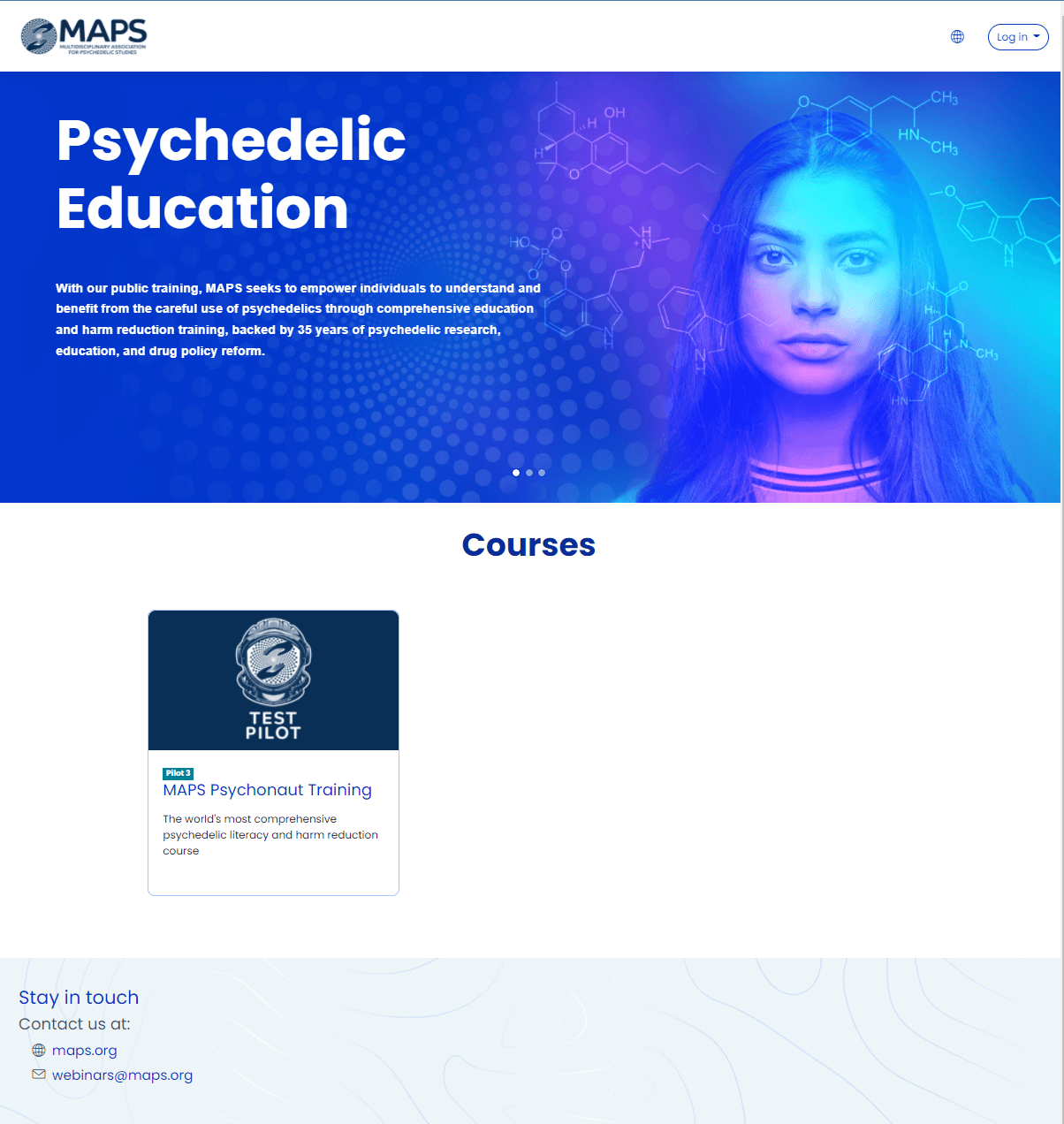
Evaluated Articulate 360 for early module authoring, then shifted to Moodle as the production platform for asynchronous delivery. Built the scalable course environment there with video production, assessment design, registration flows, and interactive learning modules.
- 7
Institutional stakeholder governance
Managed continuous review cycles with high-level MAPS internal and external stakeholders, including Rick Doblin and the advisory board, balancing creative vision with legal compliance and organizational goals.
Outcome
Built the gold standard for psychedelic literacy, delivering 12+ hours of structured content to 155 pilot participants, generating 20,000+ data points for curriculum optimization, and establishing a replicable framework for global public education.
Stack & services
- • Product management
- • Instructional design
- • Risk management
- • Operational strategy
- • Stakeholder review coordination
- • Learning platform deployment
Gallery
Interested in similar work?
Send a message or book a short intro call on Calendly.